
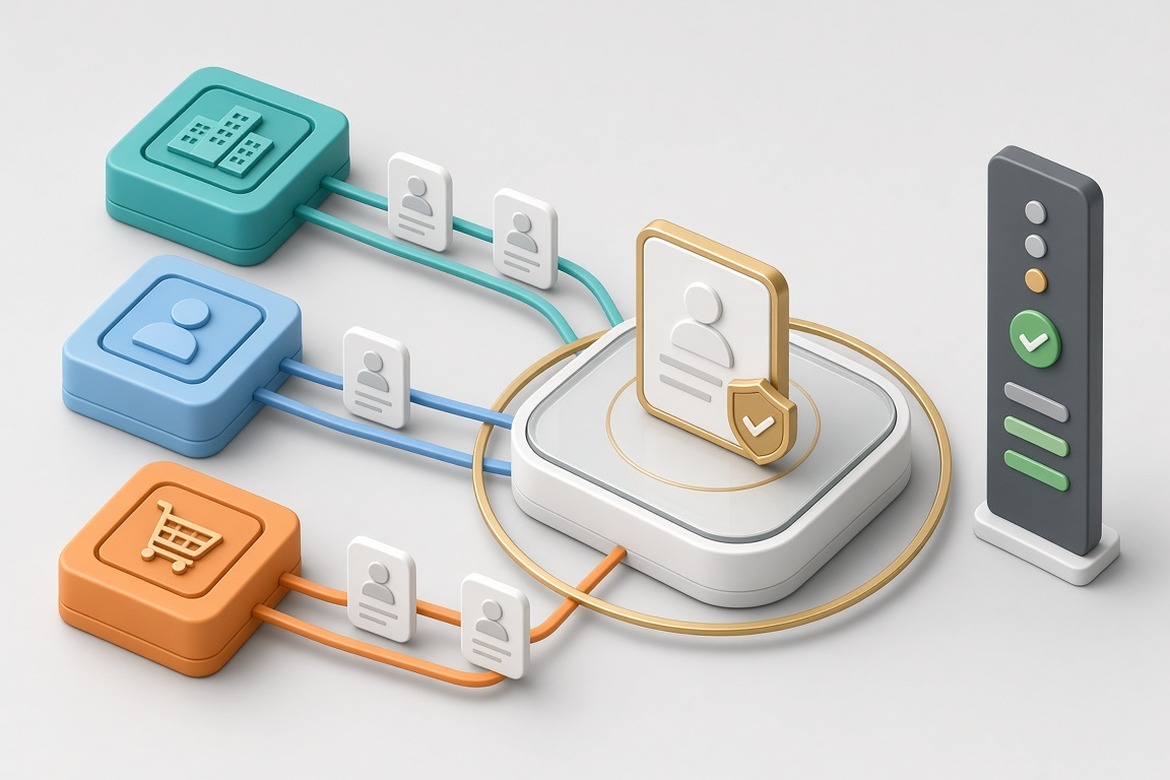
Two years after an ERP or CRM rollout, many leadership teams still see sales, finance and operations arguing over duplicate accounts, vendor terms and product codes. Software alone rarely resolves that friction. Lasting alignment comes from master data management governance: the operating model, named owners and stewardship routines that decide who defines critical records and how every connected system enforces those decisions.
Why MDM Programs Stall When IT Owns Them Alone
Most organizations agree that consistent customer, product and supplier records matter. Yet master data programs often lose steam after an initial data cleanup. The cause is rarely a software limitation; it is a mismatch between who pays for the initiative and who creates and relies on the data every day.
In McKinsey's Master Data Management Survey of more than 80 large global organizations, 80 percent reported that divisions still operate in silos with separate data practices and source systems. Only 16 percent funded MDM as an organization-wide strategic program, leaving IT to carry the financial load. As a result, 82 percent spent at least one day each week resolving master data quality issues, and 66 percent relied on manual review.
Gartner's data quality research points to a similar pattern: over half of organizations have issues with their data, and poor data quality costs at least $12.9 million a year on average. Gartner flags lack of ownership as a central barrier—business leaders value clean data, yet rarely treat it as their own responsibility. When IT is left to arbitrate definitions it did not create, governance turns into endless ticket triage.
The Roles That Make Master Data Management Governance Work
Strong master data management governance separates business decision rights from technical implementation. McKinsey found that only 29 percent of surveyed companies had both full upstream and downstream MDM integrations and all governance or stewardship roles in place. Gartner's 2025 Evolution of Data and Analytics Governance for AI Survey similarly found that just 13 percent of organizations feel fully ready to lead AI governance today, falling short on decision rights, communication and operating model design.
Rather than forming oversized committees, effective teams keep the structure lean and name accountable individuals across five roles:
Authority sits with the business. As McKinsey notes, the data owner should be a business leader—such as the head of sales for client data or supply chain leadership for product and vendor data—while IT supports integration and enforcement. Starting narrow helps too: 83 percent of respondents in McKinsey's survey cite client and product data as their dominant domains, making one of those two a practical anchor before expanding.
Choosing an Operating Model: Centralized, Federated or Hybrid
With roles defined, leaders need an operating model that fits how the company actually operates. Gartner's 2025 CDAO Agenda Survey found that 70 percent of respondents lean toward a centralized governance model—an approach often geared more toward compliance than business agility. Most organizations choose among three patterns:
Centralized governance
One central team sets definitions, approves schema changes and reviews exceptions across every domain. This suits smaller companies, early-stage programs or tightly regulated financial data. At multi-unit scale, however, a single central queue often creates delays that push teams back to local spreadsheets.
Federated governance
Business domains manage their own master data locally while adhering to shared enterprise standards. Federated models move fast because domain specialists stay close to regional pricing, channel structures or plant specs. Without shared tooling and clear escalation paths, though, divisions can slowly drift into incompatible definitions.
Hybrid governance
For most growing organizations, a hybrid model offers the best balance. A small central team maintains enterprise policies, metadata standards, classification rules and audit expectations, while domain owners and stewards handle definitions, survivorship choices and exception queues in their own systems. Gartner calls this adaptive governance—matching control to the risk and business value of each use case.
Turning Governance Rules Into System Behavior
Written policies rarely survive contact with a busy CRM or ERP. In McKinsey's survey, 62 percent of organizations lacked a well-defined process for integrating new and existing data sources. Closing that gap means turning governance rules into software behavior across APIs, forms and pipelines.
Define attribute-level survivorship rules
Different systems legitimately own different attributes of the same record. A CRM typically holds current sales contacts and account hierarchies, while an ERP holds the legal entity name, tax identifier, credit limit and billing address. Survivorship rules specify which system wins for each field and when an update can overwrite another source. Because those choices reflect business trade-offs, data owners should approve them before engineers write integration code.
Enforce data contracts at the point of entry
Fixing duplicates downstream in a warehouse is costly and always lags operations. Engineering teams increasingly pair MDM governance with data contracts—explicit agreements between source applications and consumers covering required fields, formats and freshness. Validation checks inside CRM forms, vendor portals and integration APIs catch incomplete records before they reach billing, reporting or AI pipelines.
Build stewardship workflows and active lineage
Not every match decision can be automated. When matching logic spots two similar supplier names with different tax IDs, the record should route to a steward queue with source context, lineage and a clear approve-or-split action. Industry frameworks such as DAMA-DMBOK and ISO 8000 stress point-in-time traceability so teams can audit how a record changed and why. Looking ahead, Gartner expects generative AI to accelerate the time to value of governance and MDM programs by 40 percent by 2027—helping with match suggestions and anomaly checks once clear human ownership and approval rules exist.
Metrics That Keep Governance Practical
Governance loses backing when success is measured by committee meetings rather than operational friction removed. Teams can keep the effort grounded by reviewing five domain-level KPIs every month:
- Critical attribute completeness: the share of active customer, supplier or product records with required operational fields populated.
- Duplicate rate per domain: the percentage of records representing the same real-world entity across ERP, CRM and secondary systems.
- New-record error rate: how often newly created accounts or SKUs fail validation or require manual rework.
- Steward resolution time: how quickly flagged exceptions and merge candidates are reviewed and closed.
- Manual reconciliation hours: the weekly time finance, sales operations and support spend cross-checking conflicting spreadsheets.
Pair metrics with practical change management. As McKinsey notes, technology changes alone rarely deliver value unless teams update daily habits—through executive sponsorship, clear accountability and role-specific training so sales and operations staff know why required fields exist. Connecting governance KPIs to concrete business outcomes—faster quote-to-cash cycles, fewer billing disputes and trustworthy inputs for AI assistants—keeps governance tied to measurable operational value rather than compliance checklists.
An Example from Industry Practice
Consider a pattern common among mid-sized B2B distributors growing through acquisition. The company runs one ERP for invoicing and fulfillment, a CRM for sales teams and a legacy product catalog from an acquired unit. Without clear domain ownership, sales reps create duplicate subsidiary accounts, finance tracks different parent-child hierarchies for credit terms, and product specs drift across systems.
Instead of launching a multi-year enterprise charter for every data domain, leadership begins with customer records under a hybrid model. A commercial operations VP serves as business data owner, supported by one steward from finance and one from sales operations. Working with software engineers, they set attribute-level survivorship between CRM and ERP, add tax and entity validation at account creation, and review ambiguous matches weekly. Within one quarter, billing disputes drop and downstream reporting and AI tools read from one consistent customer view.
How TISA Software Can Help
TISA Software is an AI-first software engineering company with offices in Houston, Texas and Buenos Aires, Argentina, and an ISO 9001:2015-certified quality management system. We help IT and business leaders translate master data governance into dependable systems and integrations:
- Software Factory teams that build data integration pipelines, validation APIs and stewardship workflows end to end.
- ERP, CRM and legacy integration so survivorship rules, data contracts and access controls are enforced where records are created.
- Data engineering and AI readiness to connect governed master data cleanly to analytics, reporting and production AI agents.
- Nearshore collaboration in U.S.-aligned time zones so domain stewards and engineers resolve edge cases the same day.
If unclear ownership or drifting records across your core systems are slowing down operations or AI initiatives, we'd be glad to help you build a practical governance and integration foundation. Contact us to start the conversation.