
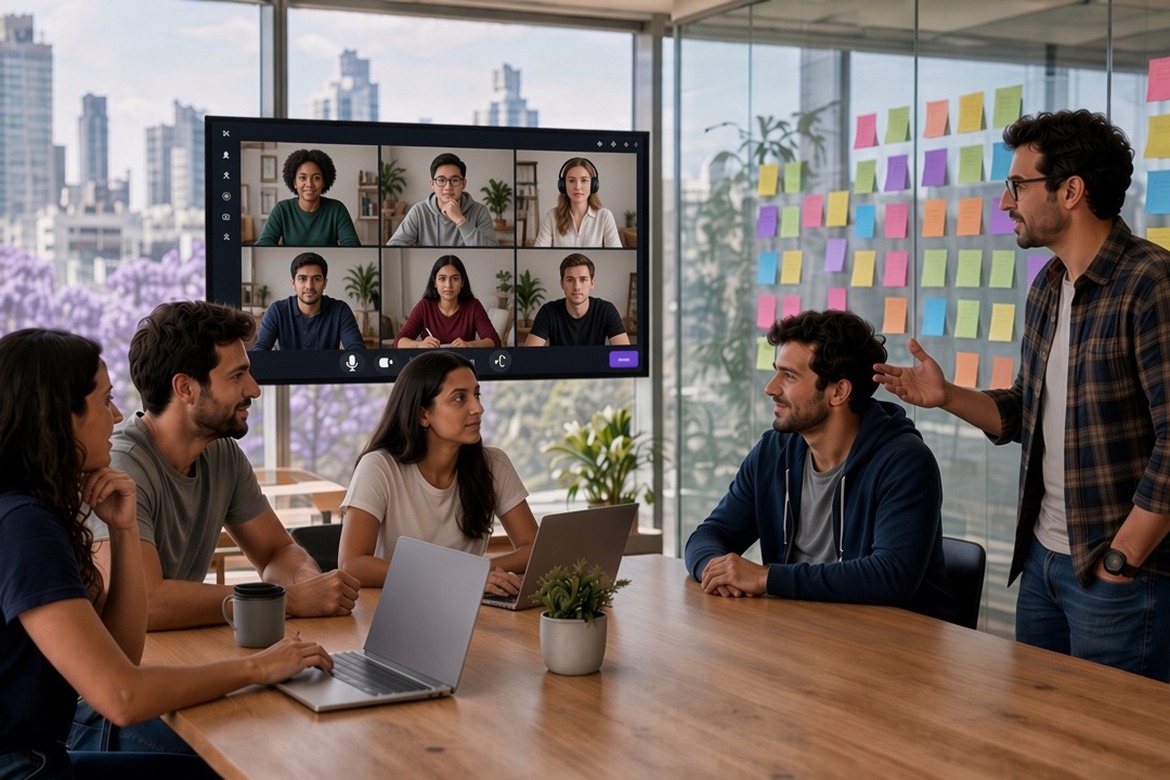
For years, the case for nearshore software development came down to one number: the hourly rate. That case has changed. Specialized talent is harder to find, AI is reshaping how software gets built, and delivery cycles keep getting shorter. Today, the questions that matter are how many working hours your teams share, how a partner uses AI, and whether the engagement is measured on outcomes rather than hours.
Why the Nearshoring Conversation Has Changed
Deloitte's 2024 Global Outsourcing Survey, based on more than 500 business and technology leaders, shows how far priorities have moved. In 2020, 70 percent of organizations cited cost savings as the main reason for outsourcing. In 2024, that figure had dropped to 34 percent. Improved access to talent now leads the list of drivers at 42 percent, followed by increasing customer demands at 35 percent.
The talent picture explains much of that shift. ManpowerGroup's 2026 Talent Shortage Survey of more than 39,000 employers in 41 countries found that 72 percent report difficulty filling roles. For the first time, AI model and application development and AI literacy ranked as the hardest skills to find, ahead of engineering and traditional IT.
At the same time, demand is not slowing. Gartner's October 2026 forecast expects worldwide software spending to grow more than 14 percent in 2027, as organizations work to industrialize AI. Teams are being asked to build more, integrate more and modernize faster, often with the same headcount.
For executives, that turns nearshoring into a capability decision. The goal is to add engineering capacity that works as part of your delivery system, not to find the lowest rate on a spreadsheet.
Time-Zone Overlap Is a Delivery Capability
Distance on a map matters less than distance on the clock. A study published through Harvard Business School, using daylight saving time changes as a natural experiment at a large multinational firm, found that a one-hour increase in time-zone separation reduced synchronous communication, such as calls and video meetings, by 11 percent. That single hour represented a 19 percent loss in overlapping business hours. Asynchronous communication did not rise to fill the gap.
The researchers also found that employees doing non-routine work, which describes most software engineering, often protected live collaboration by moving it into early mornings or evenings. That keeps work moving, but it carries a personal cost that is easy to overlook.
Nearshore teams change the math. Buenos Aires, for example, sits two to three hours ahead of U.S. Central time depending on the season, so a Houston product owner and an Argentine engineering team share most of a normal workday.
Design for shared hours, not just availability
Overlap only creates value when teams use it on purpose. Strong nearshore engagements reserve shared hours for the work that benefits most from real-time conversation: backlog refinement, design decisions, code review on complex changes, incident response and demos with business stakeholders.
Use async for what async does well
Status updates, documentation, test results and routine approvals travel well in writing. Moving them out of meetings frees the overlap window for decisions. The result is a team that collaborates live when it matters and works independently when it doesn't.
AI Raises the Bar for Nearshore Partners
AI is now part of how most engineering work gets done. The 2025 DORA State of AI-assisted Software Development report, based on nearly 5,000 technology professionals, found that 90 percent use AI at work and more than 80 percent believe it has increased their productivity. Yet 30 percent report little or no trust in AI-generated code, and DORA found that AI adoption still has a negative relationship with software delivery stability.
DORA's central conclusion is that AI acts as an amplifier. It magnifies the strengths of teams with good testing, fast feedback loops and clear workflows, and it magnifies the problems of teams without them.
Buyers already expect partners to bring AI to the table. Deloitte found that 83 percent of executives are leveraging AI as part of their outsourced services, but less than half report productivity gains, and only about 25 percent are seeing reductions in vendor service costs. Deloitte points to immature contracting structures and governance as key obstacles.
For IT leaders evaluating a nearshore partner, that means asking concrete questions:
- Which AI tools does the team use, and under what policy for code, data and intellectual property?
- How is AI-generated code reviewed, tested and secured before it reaches production?
- How do productivity gains from AI show up in the engagement: faster delivery, broader scope or lower cost?
- Which delivery metrics will both sides track from the first sprint?
Shorter feedback loops matter even more when AI speeds up code generation. A team that shares your working hours can review, question and correct AI-assisted work the same day, rather than discovering issues overnight.
Choose the Engagement Model That Fits the Outcome
Nearshoring is not one model. The right structure depends on who owns the outcome and how much management capacity you have in-house.
Deloitte's data suggests the market is moving toward more mature models. Among organizations using managed or operated services, 88 percent say outsourced services meet or exceed their satisfaction levels, compared with 71 percent of those that don't use them. In Deloitte's words, organizations "are interested in buying capabilities and outcomes, and not hours."
Many organizations combine models, using staff augmentation for a short-term skill gap while a managed team delivers a modernization program.
Measure What Matters After Kickoff
The first 90 days set the pattern for the whole engagement. Leaders who treat a nearshore team as part of the delivery system measure it the same way they measure internal teams:
- Delivery flow: lead time for changes, deployment frequency, change failure rate and recovery time.
- Quality: escaped defects, test coverage on critical paths and review turnaround.
- Collaboration: whether shared hours are protected and decisions are made within a day.
- Business outcomes: progress on the roadmap items the engagement was created to deliver.
Clear measures also make the conversation about AI productive. If AI-assisted development is improving throughput without hurting stability, both sides can see it and decide how to use the extra capacity.
An Example from Industry Practice
Consider a common situation for a mid-sized U.S. manufacturer. Its internal team maintains an ERP integration layer and a customer portal, and the roadmap now includes AI-assisted order processing. Hiring locally for the required skills has been slow, and an earlier offshore arrangement struggled because most questions waited overnight for answers.
A typical nearshore approach starts small. The company and its partner agree on a managed delivery model for the new order-processing capability, with a named product owner on the client side and a partner team lead. Shared morning hours are reserved for refinement and reviews. AI coding assistants are used under a written policy, with automated tests and human review required on every change. Delivery metrics are reviewed every two weeks alongside the roadmap.
In a well-run engagement, the internal team spends less time coordinating and more time on the business decisions only it can make, and leadership has a clear view of what the extended team delivers.
Where to Start
- Define the outcome first, whether it is a skill gap, ongoing capacity or a defined deliverable.
- Set a minimum overlap of working hours and decide which activities use it.
- Ask partners how they use and govern AI, including review, security and intellectual property.
- Choose the engagement model that matches who will own day-to-day delivery.
- Agree on shared metrics for flow, quality and business outcomes before the first sprint.
- Start with a focused scope and expand once the team proves it can deliver.
How TISA Software Can Help
TISA Software is an AI-first software engineering company with offices in Houston, Texas and Buenos Aires, Argentina, and an ISO 9001:2015-certified quality management system. Our nearshore model is built for close collaboration with U.S. teams:
- Software Factory teams that own delivery of defined products, modernization and integration work, with testing and transparency built in.
- AI-first development teams that use AI-assisted engineering with clear policies, human review and quality gates.
- Staff augmentation to add experienced engineers who work in your time zone and fit into your existing processes.
- ERP, CRM and legacy modernization experience for programs where business systems need to evolve without disruption.
If you are rethinking how to add engineering capacity, we'd be glad to help you find the model that fits. Contact us to start the conversation.